The Universal Governance Protocol
Open standard · royalty-free Foundation-stewardedOne protocol for how governance travels, open where it teaches, licensed where it proves.
A single wire protocol carrying declared constraints, verdicts and provenance across organisations, vendors and hardware, so a governance claim means the same thing everywhere it is checked.
The open / proprietary split
One protocol, two halves, and they need each other.
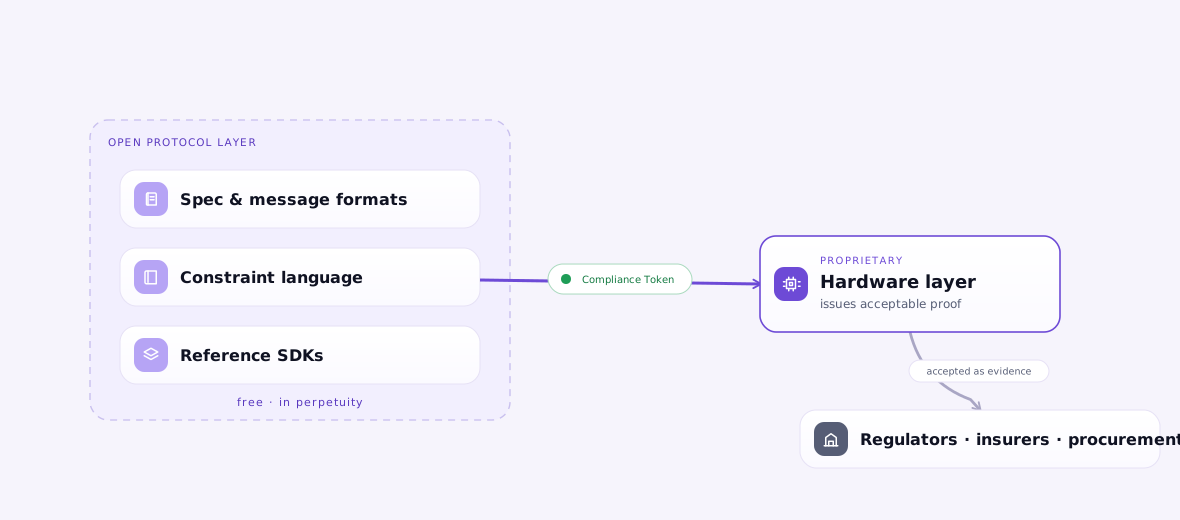
The specification, schemas and conformance suites are open and free. The cryptographic attestation that makes a verdict trustworthy across a trust boundary comes only from licensed hardware. The protocol is one thing; only its two halves together make a claim that holds.
"The openness is what makes it a standard; the hardware is what makes it true."
The open specification
Published now, on GitHub.
The open layer, enumerated
Everything free, named.
Message formats & wire schema
Versioned, the bytes on the wire are public.
State-machine definitions
Handshake and lifecycle, formally specified.
FCSL
The Formal Constraint Specification Language, expressing the reference set, per-lane operating points, and arbitration policy.
Reference implementations
Conformance baselines anyone can build against.
Compliance test suites
Certify an implementation by reproducing an arbitrated verdict, not just a distance.
SDKs
Python, TypeScript, Rust, C++.
The bridge
Software conformance is free. The cryptographic attestation regulators, insurers and procurement accept comes only from licensed hardware. The compliance token is the boundary object.
Licensing →Vocabulary profiles over one substrate
Declared → one layer → enforced-and-proven, per domain.
AGP
AI Governance Protocol. Attests that an AI output was governed against its constraint set before it was acted upon. EU AI Act, ISO 42001.
SGP
Security Governance Protocol. Continuous, attested security posture, process attestation rather than configuration snapshots. NIS2, IEC 62443.
FA-GP
Frontier AI Alignment. Training- and alignment-time governance linked to deployment evidence. EU AI Act GPAI, CA SB 53.
MA-GP
Multi-Agent Governance. Keeps governance and provenance intact across agent hand-offs, tool use, and collective action.
DLGP
Data-Lifecycle Governance. Governs data at rest, in transit, and in use, linked into one lifecycle chain.
CDP
Constraint Declaration. Lets a third-party vendor declare constraints that are scope-bound and reconciled against the operator's floor, not blindly trusted.
Beyond the core six, a catalogue of domain profiles specialises the protocol for cloud-native, industrial control, radiation oncology, autonomous vehicles, aviation, on-device agents, and more, each producing tokens in the same universal format. Browse the domain profile catalogue →
Governance of the standard
Who keeps it open, and how it changes.
Foundation stewardship
To be custodied by the independent Casuarina Foundation (being established). How we're structured →
Public-access guarantee
Specifications permanently free. Implementation requires licensing only at the hardware attestation layer. Understanding never does.
The change process
Versioned, public, and open to implementers, no vendor privately redefines the wire.
The honest boundary
The protocol layer is open. The separation property and error bounds of the enforcement layer remain design claims pending experimental validation.
Rule 6's carrier, provenance travelling with the output in a format no vendor privately defines. The eight rules →