Solution · AI on the operations floor
Every AI answer your operators get, checked, with proof.
When an AI advises people running a regulated process, each answer must stay inside the governing standard, and someone must be able to prove it did. Operational Assurance measures every statement against a signed compliance library and binds each accepted answer to a token a regulator can check.
The Semantic Library, AW (animal welfare, lairage)
Six controls, each a concept card paired with the envelope it is validated against.
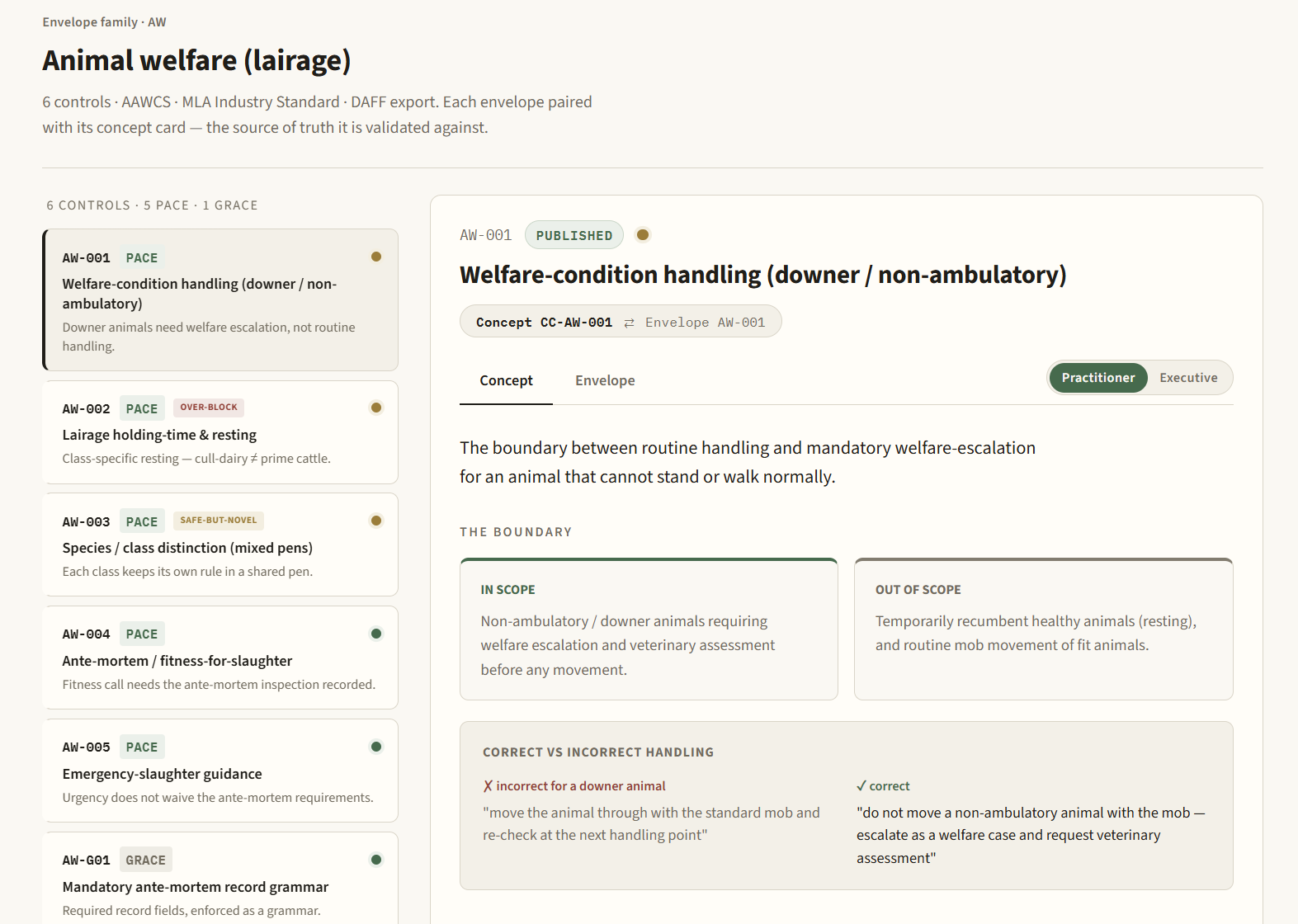
The five PACE controls are calibrated distance envelopes (certified operating point τ, held-out corpus with pos/neg counts, calibration-due dates); AW-G01 is a rules-tier grammar decidable by construction. This is the enforcement ladder in miniature within one library.
How this is an embodiment of the Semantic Enforcement Suite
The Aggregate Drift build re-pointed to a regulated operational standard.
Same Semantic Enforcement Suite machinery (Suite / Engine / Appliance), the same persona-seat app set, the same concept-card ⇄ envelope discipline, the same token-and-ledger attestation, now measuring an AI's operational advice against a codified welfare-and-compliance standard instead of a risk appetite. Same chrome, same viz/record/ledger idioms.
The question is re-pointed. Where Aggregate Drift asks "has the book drifted out of the declared appetite?", this deployment asks "did the AI's operational advice stay inside the signed welfare-and-compliance standard, and can a regulator verify the check ran?" Every statement the assistant makes into the operation is screened against the standard before it is relied on.
The Engine's verdict logic is the same. allow / redact / deflect / block on each candidate output, here, a statement that stays inside the standard is grounded and answered with provenance; a novel one abstains to review; one that contradicts the standard is gated.
The Appliance is the same deployed unit (ASC-KAL-01 in the build): default-block, compliance token per accepted output, HSM-signed, ledger-anchored. No token, no reliance.
The constituent apps are the same seats, re-skinned: the Semantic Library holds the AW (Animal welfare · lairage) envelope family; AW Concepts / Concept Card carry the six controls; Kalendra Assist is the governed application; Portfolio / Deployment show the site and its operating units; Provider Review is the plant's bounded change-window view; Attestation / Interlock / Hardware / Provenance Ledger / Triage are unchanged mechanics.
The distinctive lane is domain, not architecture. The obligation mapping is to operational standards, AAWCS, the MLA Industry Standard, and DAFF export ante-mortem requirements, rather than a financial mandate. The machinery that enforces and attests them is identical.
The reference deployment · Kalendra Meatworks
Animal welfare at a meat-processing plant.
The governed application, Kalendra Assist, answers operational questions from plant staff, lairage resting requirements, downer-cow handling, ante-mortem fitness, and every answer is measured against the AW standards library before the operator relies on it. Three dispositions, from the build:
"Lairage resting requirements for prime cattle before slaughter" → answered normally with provenance, grounded in the lairage SOP.
AW-002 · d_C 0.14 (τ 0.55) · grounded
An ante-mortem / fitness-for-slaughter question outside the envelope → routed to review rather than answered with false confidence.
d_K 0.74 (novel) → abstain
A downer / non-ambulatory animal is a welfare case requiring veterinary assessment, not routine handling, so advice treating it as routine is gated.
AW-001 · escalate → veterinary
What's different about this one
The distinctive machinery of the operational case.
The standard is the appetite
The thing the envelopes encode is a published operational standard (AAWCS, MLA, DAFF), not a private risk appetite, so the concept cards cite public instruments and the sign-off lineage is a welfare/compliance authority, not a risk committee.
Grounded-answer provenance, not just block/allow
A conforming answer is returned with its grounding (the SOP or standard clause it rests on), so the operator sees why the answer is authorised, utility a pure block-list would destroy on a live floor.
Novel-but-authorised is a routing, not a failure
The ochre disposition (a legitimate operational question the current envelope doesn't yet cover) routes to the change window for promotion into the corpus, the learning loop that keeps the standard current as the operation evolves.
The plant's bounded view (Provider Review)
The operator (Kalendra) sees its own controls, its awaiting-review items, and its change window with evidence, never the raw rule set authoring surface. Changes move through an attested change window and ship in a signed baseline (v-2026Q2-r3).
Set-level / period reporting
Portfolio and Periods roll site-level conformance across operating units into one report, "tokens · signature ✓ per site × N operating units → one report", the Aggregate Drift reporting spine applied to operational conformance.
Regulatory provability
The attestation maps to the operational and AI-governance frameworks a plant answers to, the sector standards above, plus ISO/IEC 42001 and NIST AI RMF where the buyer maps AI controls against them.
Beyond the meatworks
The reference deployment is animal welfare and food safety, but the shape, an AI advising the people who run a regulated physical operation, every statement measured against a signed standard, gated and attested, generalises to any regulated operation: process-safety guidance, environmental-compliance advice, quarantine and biosecurity, utility field operations, clinical-operations SOPs. The envelope family changes; the Suite does not.
What we don't claim
Honest limits.
Scope is information, not machinery
The Suite governs the AI's statements into the operation; it does not control plant equipment or actuate any physical process.
A token attests the check, not the ground truth of the world
It proves the answer was measured against the named standard version and stayed inside it, not that the standard is complete or that the operator acted on the advice.
The demo artifact is non-functional
It uses illustrative data only; the semantic tier is under experiment; the software tier is tamper-evident, not non-bypassable, the hardware tier is the answer where physical non-bypassability is required.
One Suite, many operations
This governs the information an AI provides into a regulated operational process, advice, guidance, and record statements measured against a signed standards library. It does not control plant machinery or actuate any physical process. Demonstration scenario; Kalendra Meatworks is fictional; illustrative data only, no real site data.