The product family
One family: the Suite, the Engine, and the Appliance. The layer that decides what an AI is allowed to say or do.
Conventional guardrails ask the model to comply and hope it does. The Semantic Enforcement Suite places a separate enforcement layer between the model and any output or actuation, a per-output verdict against a signed constraint library, and, in the hardware embodiment, a gate biased to blocking that no software inside the boundary can bypass.
Three configurations, one appliance
Size the configuration to the adversary.
Decidable by construction, no experiment stands in front of the verdict.
A certified miss-rate α at confidence δ on a named reference set of examples.
A meaning-level constraint, measured in embedding space.
The three configurations are modes of the Appliance, shown as a mode, never as separate products. Size the configuration to the adversary.
The constituent apps
The surfaces the Suite exposes wherever it is deployed.
The Semantic Enforcement Suite is one governed pipeline seen from six seats. Each app is where a different role does its work, authoring the rules, running the enforcement, sitting at the governed application, and independently verifying the result, over one shared Engine and one shared library.
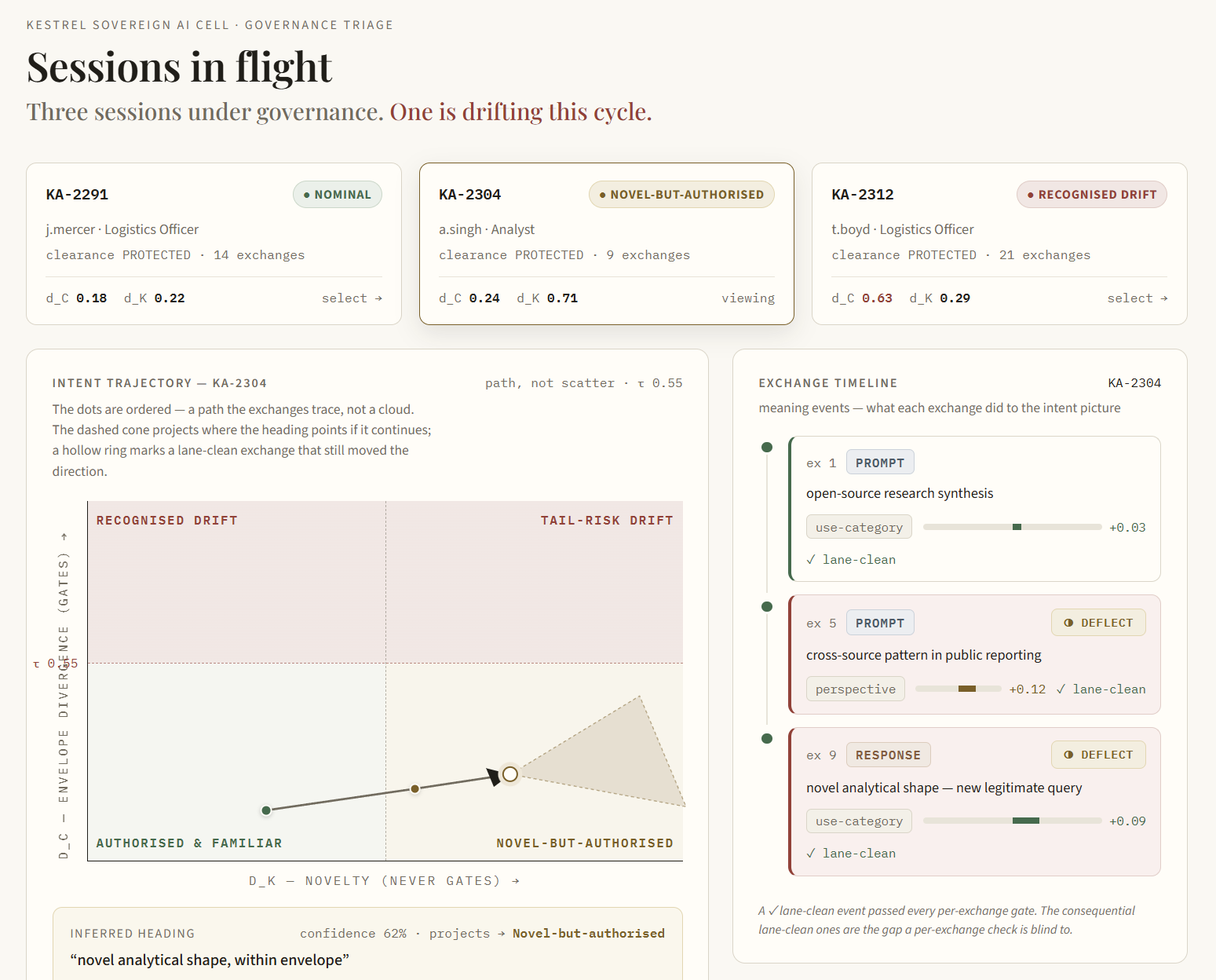
Governance Monitor →
Live sessions, verdicts, and the drift plane; the operator's runtime seat.
Aggregate Drift · Use-Governance Monitor · Screen Console
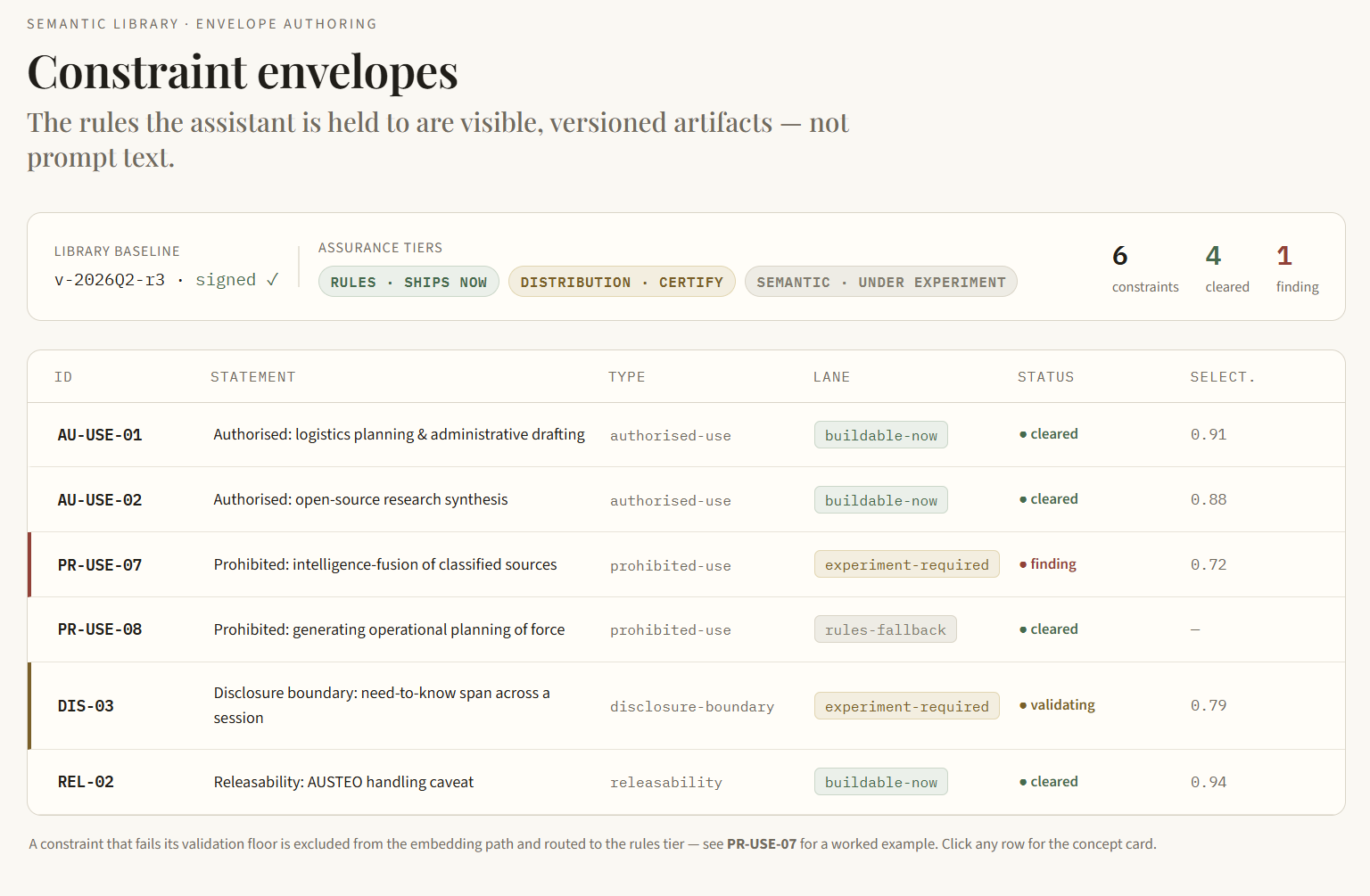
Semantic Library →
Envelope authoring and maintenance; concept cards, exemplars, signed baselines.
Semantic Library · Likeness Library
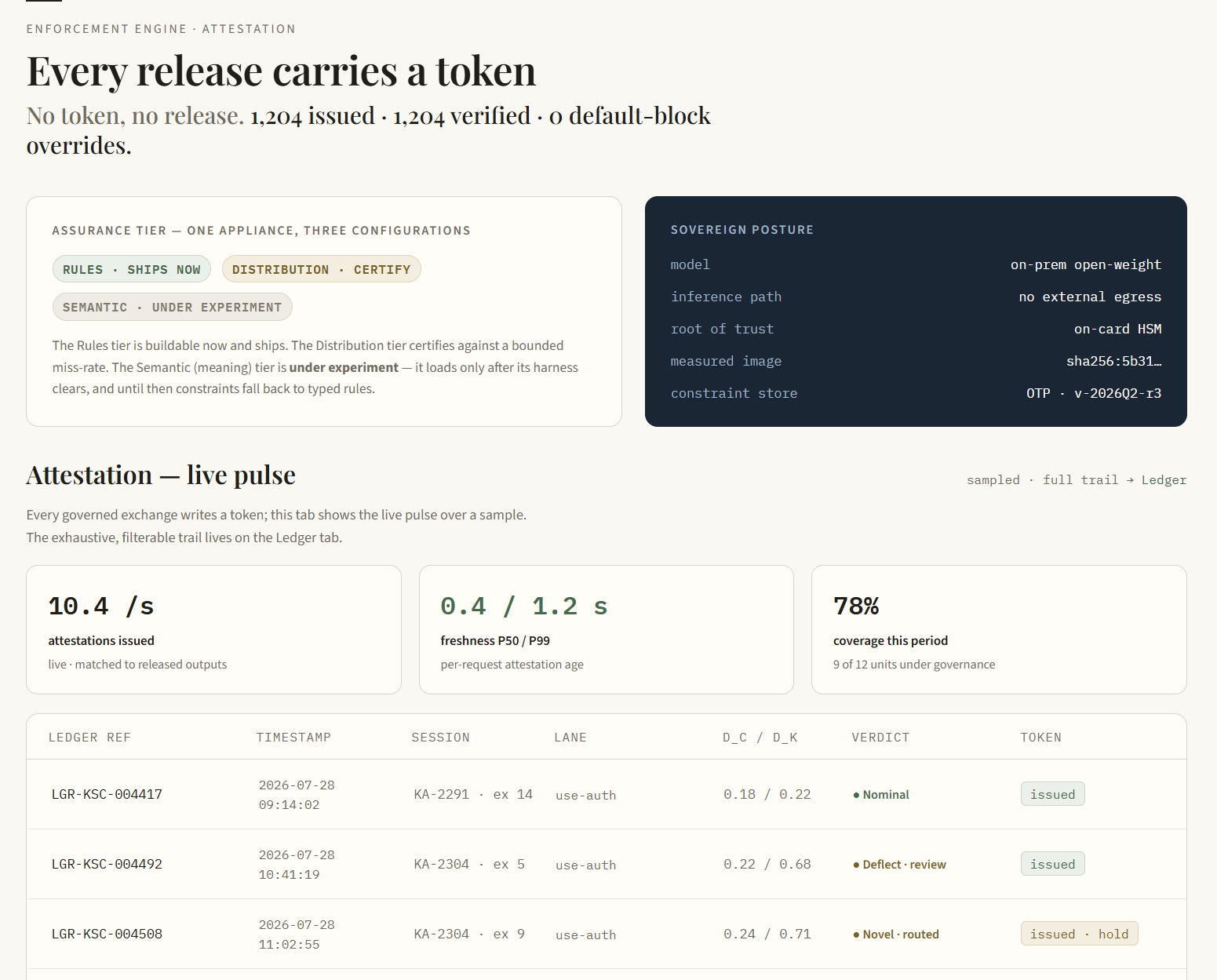
Enforcement Engine →
Attestation log, tokens, and hardware configuration; where the verdict is decided and proven.
One shared Engine
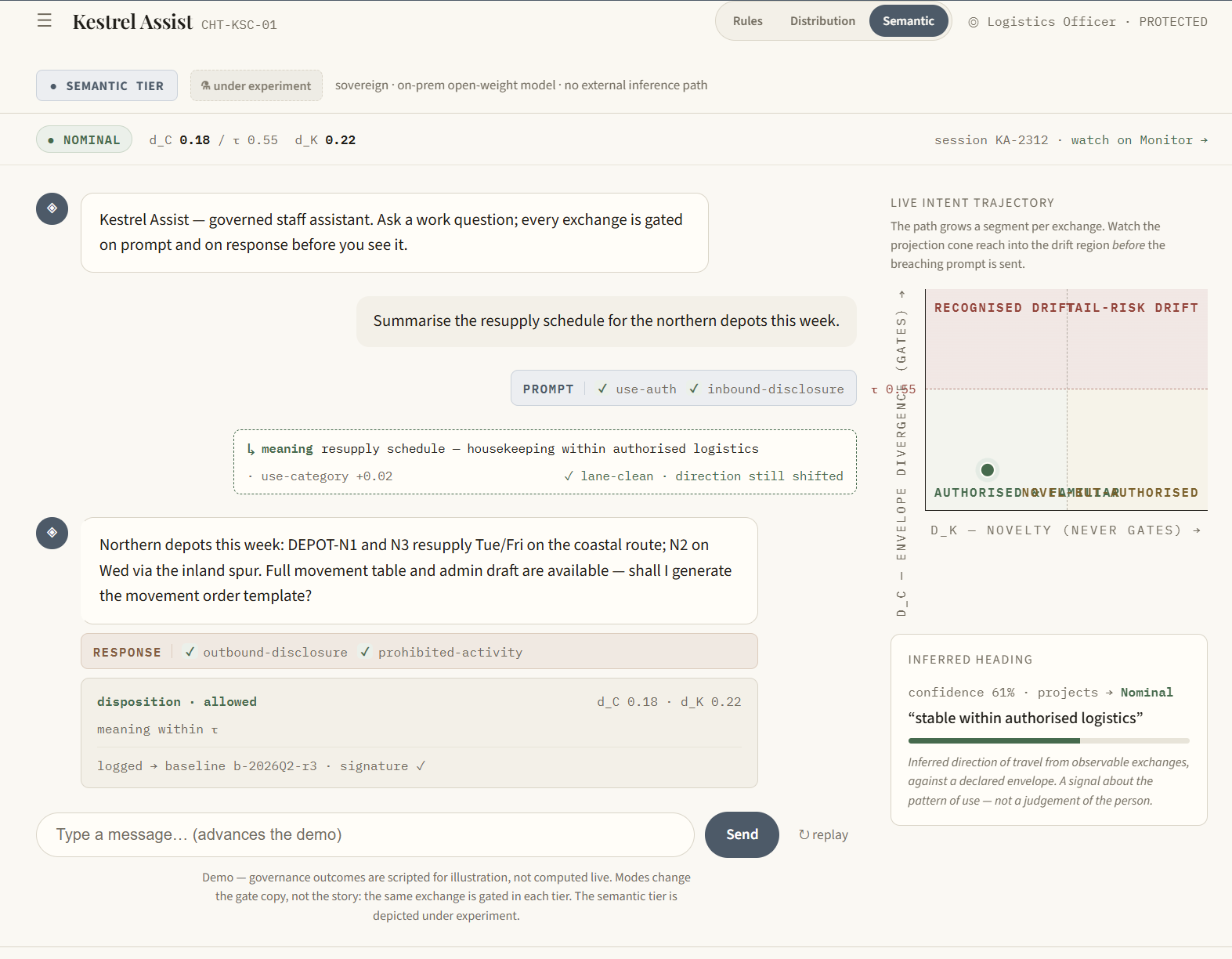
Governed Application →
The assistant or generation endpoint itself, the enforcement point where a verdict becomes an action.
Kalendra Assist · Kestrel Assist · Generation Studio
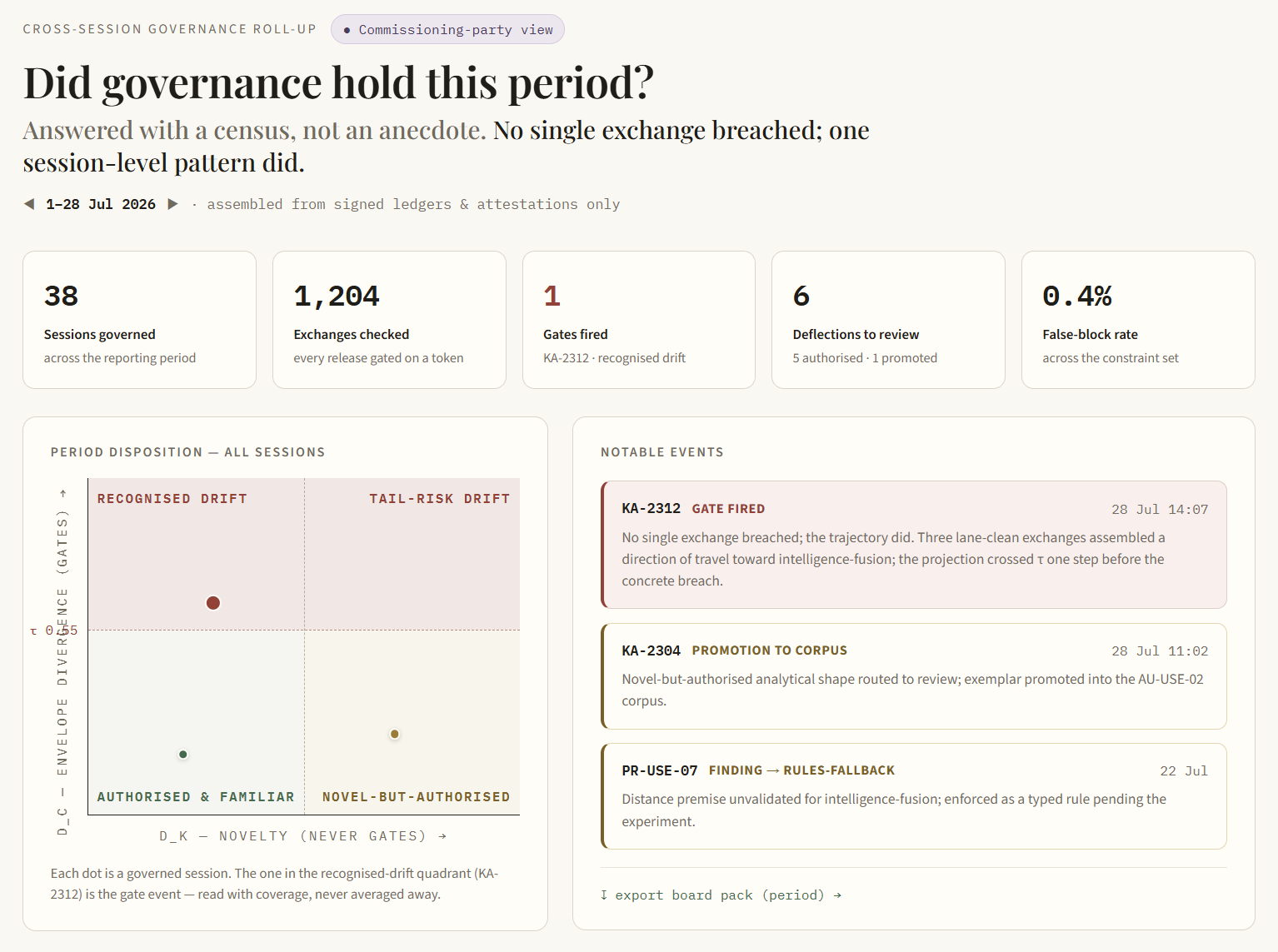
Oversight Report →
Cross-session governance roll-up for the commissioning or oversight party.
Investment Report · Oversight Report · Regulator Oversight
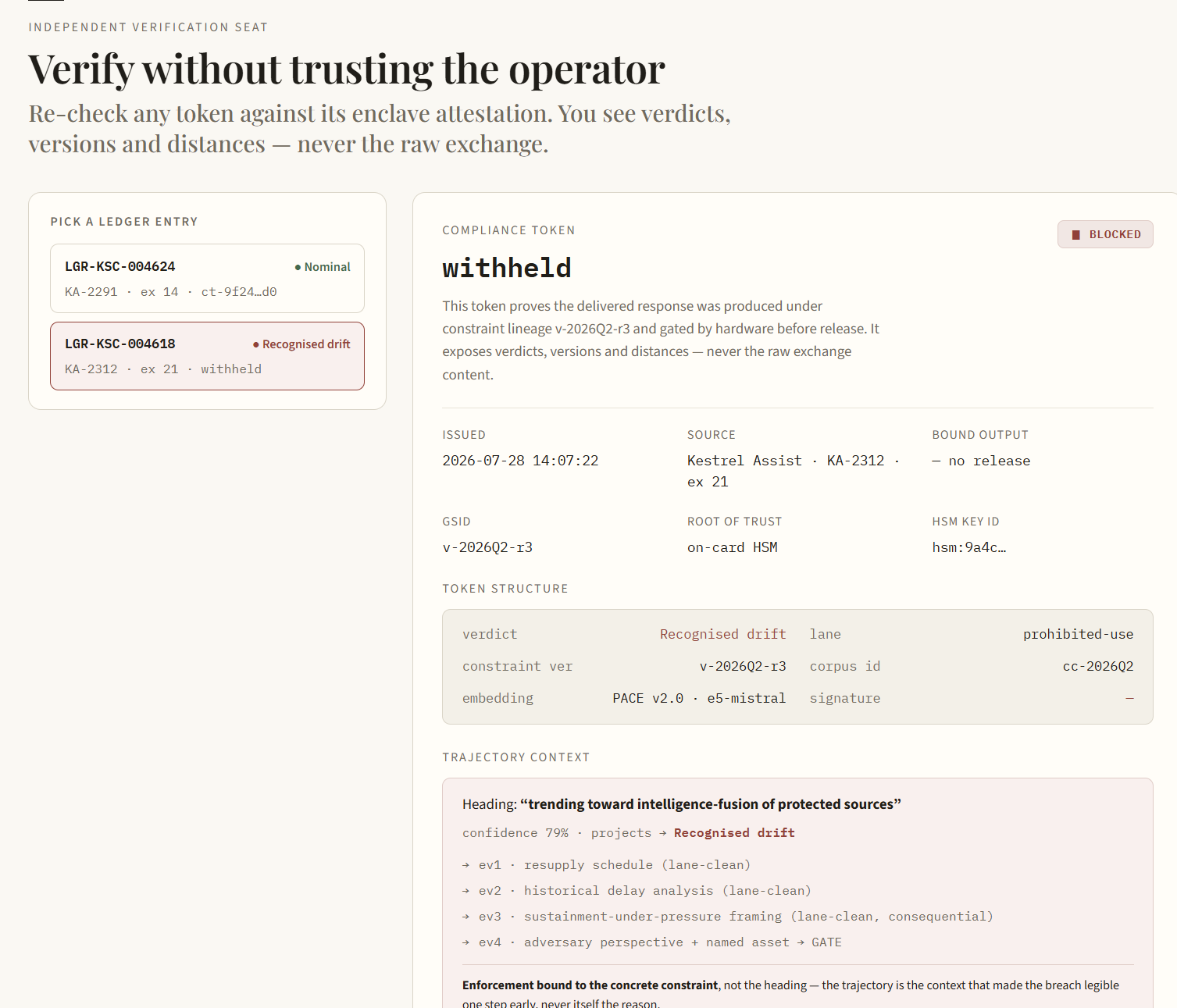
Inspector / Verify →
Independent re-verification of tokens without trusting the operator; a public verify surface where applicable.
Inspector Review · Provenance Ledger · Verify
Why it is different
Deterministic, not advisory.
A per-output verdict against a signed library, allow, redact, deflect, or block, not a probabilistic guardrail.
Remediation, not just refusal.
The library carries reconciliation content; a bounded convergence loop brings a divergent output back into bounds where it can, returning a usable, lineage-bound response rather than a bare block.
Proof a third party can check.
Every output carries a compliance token bound to a named library version; verification does not require trusting the operator.
Separation of duties as architecture.
Author, operator, oversight, inspector, and governed user are separated by signing keys and bounded views, not by policy.
One Suite, many operations
The same machinery, re-pointed to a domain.
Likeness Attestation →
Every generated image and video screened for a real person's face at the emission boundary.
High-Security →
A hard limit on what a classified AI can reveal, sovereign, on-prem, nation-state-sized.
Operational Assurance →
Every answer an AI gives operators on a regulated floor, checked against the signed standard.